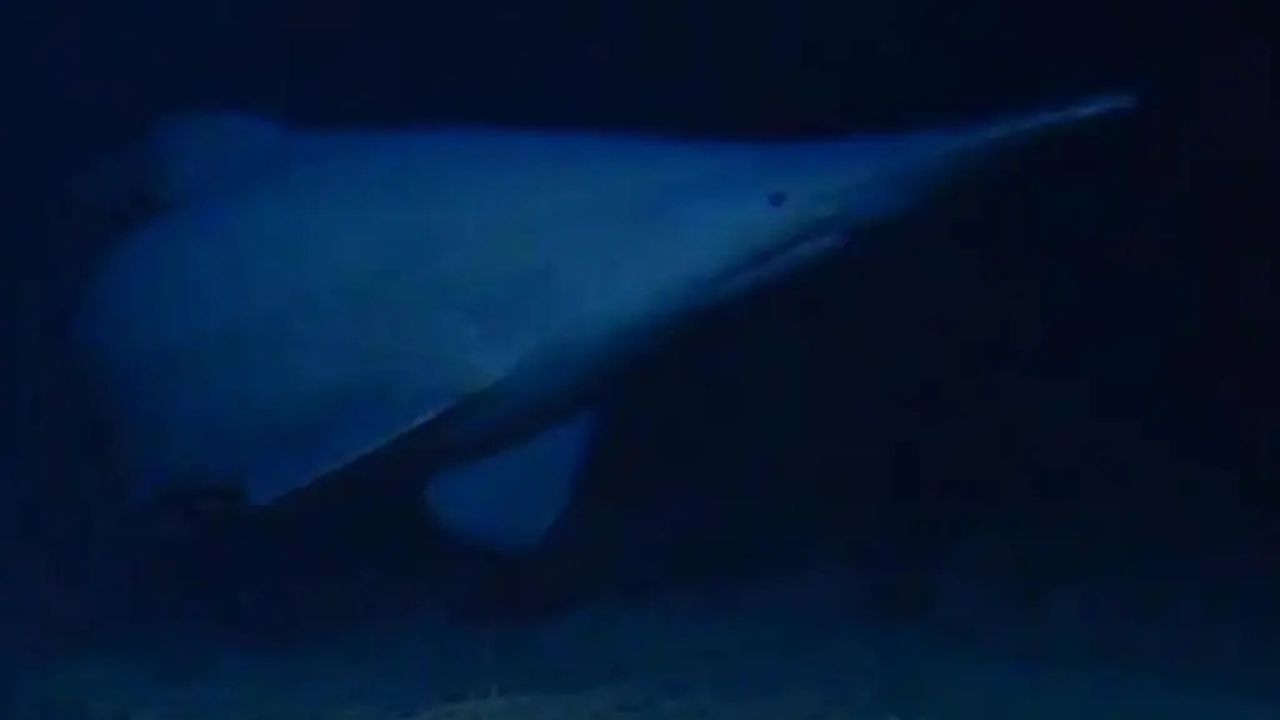
Tonga Trench, South Pacific Ocean — One of the ocean’s most mysterious and rarely seen creatures has finally been observed alive in its natural environment, marking a major breakthrough for marine scientists studying life in the deep sea.
Researchers have confirmed the first-ever sighting of a goblin shark in its natural habitat, capturing footage of the elusive predator thousands of feet beneath the ocean’s surface in the Tonga Trench. The remarkable discovery offers an unprecedented glimpse into the life of a species that has fascinated scientists for more than a century.
The findings were detailed in a study published last month and are being celebrated as a significant achievement in deep-sea exploration.
Rare Shark Captured on Camera in Extreme Ocean Depths
The goblin shark has long been considered one of the ocean’s most unusual and mysterious animals.
Although the species was first identified more than 100 years ago, nearly all previous encounters occurred when sharks were accidentally caught by fishing operations. As a result, scientists had never observed the species behaving naturally in its deep-sea environment.
Using a remote baited camera system deployed in the Tonga Trench during 2024, researchers finally captured footage of the elusive predator swimming in the darkness of the deep Pacific.
Marine biologist Alan Jamieson described the moment as something he never expected to witness.
“The Goblin Shark is one of these deep-sea charismatic animals that I never thought we’d see alive, and then to do so was amazing, but to then learn that colleagues in Hawaii also saw one was just incredible.”
The sighting provides valuable information about how and where the species lives far below the reach of sunlight.
Earlier Footage May Have Captured the Species Years Ago
Following the Tonga Trench discovery, scientists revisited older deep-sea footage and realized another goblin shark may have been recorded years earlier.
Researchers now believe video captured by the exploration vessel M/V Nautilus near Jarvis Island and Palmyra Atoll in 2019 likely showed the same species.
The two discoveries together have dramatically expanded scientists’ understanding of the shark’s distribution across the Pacific Ocean.
Researchers say the findings suggest goblin sharks may inhabit a much broader area than previously believed.
Discovery Shatters Previous Depth Record
The Tonga Trench sighting also revealed something unexpected about the shark’s preferred habitat. According to researchers, the animal was found nearly 700 meters deeper than scientists previously thought the species inhabited.
Aaron Judah, a researcher with the University of Hawaii, said the discovery challenged existing assumptions about the species.
“Seeing the most iconic of all the deep-sea sharks alive and looking healthy in its natural habitat is a unique honour.”
He added:
“I was also very surprised about how deep this species was found. The observation from the slope of the Tonga Trench is nearly 700 meters deeper than this species was known to live.”
The encounter ultimately established a new depth record for the species and expanded knowledge of its ecological range.
A Living Fossil From Another Era
The goblin shark is often described as a living fossil because of its ancient lineage and unusual appearance.
Growing to an average length of around 12 feet, the species is known for its soft, almost translucent body, elongated snout, and rows of sharp protruding teeth.
Scientists say it is the last surviving member of a family line that dates back approximately 125 million years, making it one of the most ancient shark species still swimming in today’s oceans.
Severe Storms Could Return to Illinois This Weekend After Tornado Outbreak, Forecasters Warn
The discovery could also have important conservation benefits. Now that researchers have documented the shark in these deep Pacific regions, the species can be included in biodiversity records and future wildlife management planning.
Deep Ocean Continues to Reveal New Secrets
Despite decades of marine exploration, scientists say the deep ocean remains one of the least understood environments on Earth. Discoveries like the goblin shark sighting highlight how much remains unknown beneath the surface.
“New discoveries like this demonstrate that there is still so much to explore in our deep ocean home,” Judah said. “Beforehand we didn’t know it was even there!”
For researchers, the historic sighting serves as a reminder that some of the planet’s most extraordinary creatures are still waiting to be discovered in the vast depths of the ocean.
What do you think about this incredible discovery? Would you like to see more deep-sea exploration projects focused on uncovering unknown marine life? Share your thoughts respectfully in the comments below.